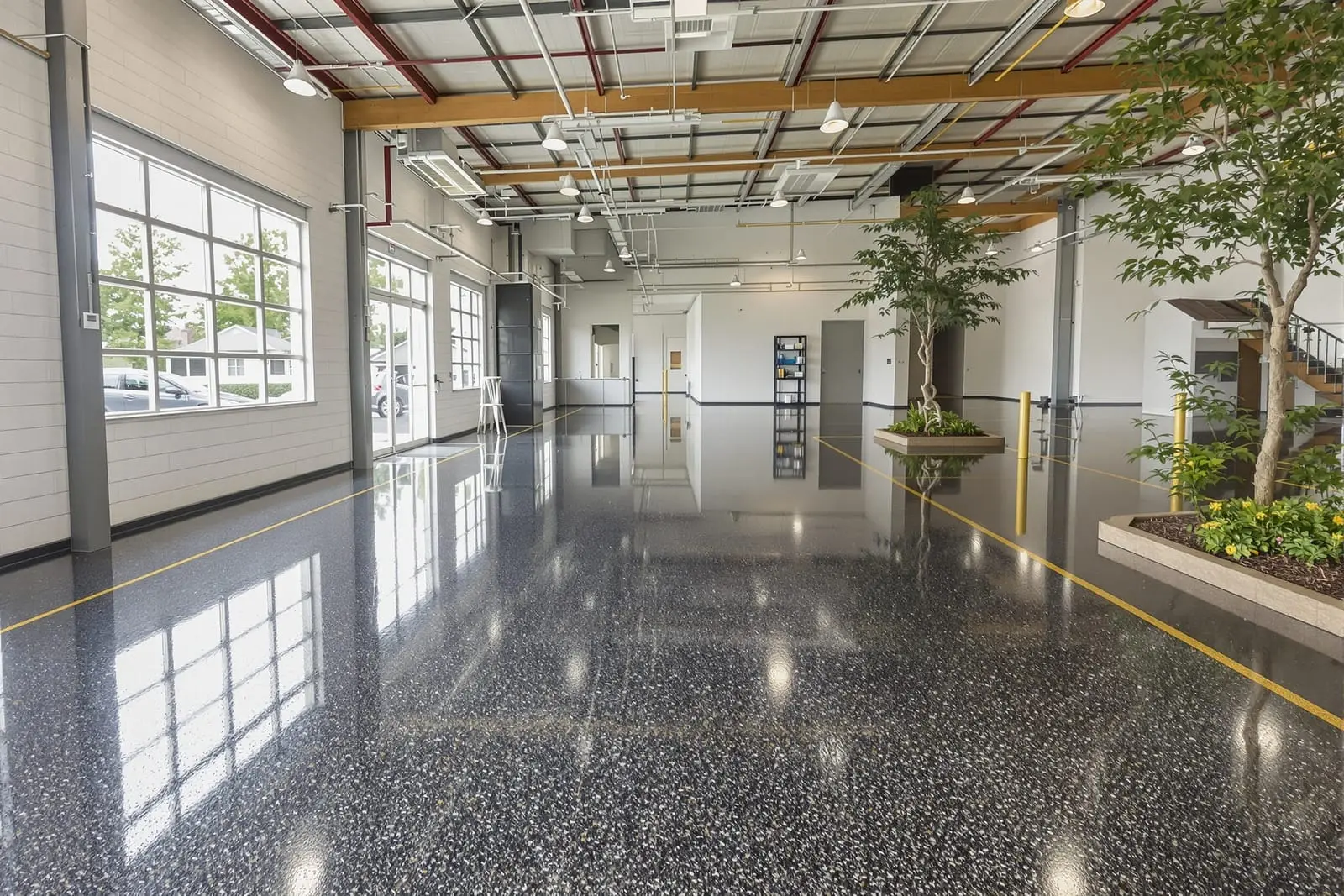
Support your operations with durable industrial concrete floors in Grand Rapids, MI. We pour high strength slabs for warehouses, factories, and shops designed for forklift and rack loads. Our team controls flatness, joints, and reinforcement so your floor performs under heavy use.
Primetime Concrete Grand Rapids provides professional industrial concrete floors throughout Grand Rapids, MI and the surrounding area. Our licensed, insured crew delivers safe, clean, on-time work with a free estimate before anything begins. Call (231) 888-1647 or request your free quote.
Durable industrial concrete floors for working Grand Rapids warehouses
Warehouse and industrial concrete floors in Grand Rapids take a beating from forklifts, pallet jacks, racking loads, and Michigan freeze-thaw cycles. At Primetime Concrete Grand Rapids, we design floors around how you actually use the space, not just square footage. Before we talk mix designs or reinforcement, we ask about your forklift weights, rack layout, traffic paths, chemical exposure, and any future expansion plans. This helps us choose slab thickness, joint layout, and surface treatment that will hold up in real-world use.
In West Michigan, temperature and moisture swings matter. Older warehouse slabs here often curl at joints or develop random cracking because the subbase was not compacted correctly or moisture barriers were skipped. We start with a thorough site evaluation, including checking existing soil conditions, drainage paths, and any buried utilities. If we are replacing an old slab, we look for signs like pump-up of fines under traffic, heaving near overhead doors, or moisture problems that could affect a new floor. This local experience shapes the way we design every industrial concrete floor we pour in the Grand Rapids area.
How we build warehouse & industrial concrete floors step by step
The work starts with preparation. For new construction, we grade and compact the subbase in thin lifts using plate compactors and rollers, then test firmness so it can carry heavy point loads from racking systems. For replacement floors, we saw-cut and remove existing slab sections, haul away concrete, then proof-roll the subbase to find soft spots and correct them with engineered fill. In many Grand Rapids industrial buildings, we also install a vapor barrier on top of the compacted base to protect floor finishes and sensitive inventory from ground moisture.
Next is layout, reinforcement, and mix design. We set elevations carefully so finished slab heights match dock levels, door thresholds, and existing floors, which is critical in older Grand Rapids warehouses where additions have been built at different times. Depending on load requirements, we may use rebar, welded wire fabric, or structural fiber reinforcement. For many industrial concrete floors that see high forklift traffic, we prefer a low-shrinkage, high-strength mix, often in the 4,000 to 5,000 psi range, and we adjust air content for interior versus semi-exposed areas near overhead doors.
Placement and finishing are timed around Michigan weather. In colder months we may need heated enclosures or ground thaw blankets to keep the slab from freezing during curing. In warmer, windy conditions we stage extra manpower to control evaporation and prevent surface crusting, which can lead to scaling later. We use laser-guided screeds or tight string-line controls to achieve flatness suitable for racking aisles. Finishing often includes a machine trowel to a hard, dense surface, then, if requested, a dry-shake hardener or early-entry joint layout to control cracking in critical areas.
Surface options, coatings, and long-term performance
Not every warehouse floor needs the same surface treatment. Some facilities in Grand Rapids that store dry goods prefer a plain hard-troweled surface that is easy to sweep and economical to install. Others, like manufacturing plants or distribution centers with tight cleanliness standards, benefit from densifiers and sealers. At Primetime Concrete Grand Rapids, we often recommend a lithium or sodium silicate densifier that penetrates the slab, reduces dusting, and improves abrasion resistance without peeling like some coatings.
For customers handling oils, solvents, or food products, we discuss resinous coating systems on top of the industrial concrete floor. Epoxy or urethane systems can provide chemical resistance, safety striping, and light reflectivity, which can reduce lighting costs in large Grand Rapids warehouses. The slab underneath must be designed with coatings in mind, including proper moisture mitigation to prevent blistering. That is why we look at moisture testing options, such as relative humidity probes, before any high-performance coating is installed.
Slip resistance and maintenance are also key. Extremely smooth, shiny floors may look great but can be dangerous in wet loading areas. We can adjust finish techniques, add non-slip additives to coatings, or create different surface zones for aisles versus wash-down or dock areas. We also provide practical maintenance guidelines, for example which cleaners will protect, not harm, your densifier or coating, and realistic schedules for joint inspections in high-traffic forklift lanes.
What drives cost for industrial concrete floors in Grand Rapids
Industrial concrete floor pricing is driven by more than just square footage. Slab thickness, reinforcement type, loading requirements, and access all matter. A light-use storage space with minimal forklift traffic might perform well with a 5 inch slab and wire reinforcement. A high-bay warehouse with narrow-aisle lift trucks and very tall racking may need a thicker slab, tighter flatness tolerances, and more robust reinforcement, which increases material and labor costs.
Existing conditions are another big factor. In older Grand Rapids industrial districts, we often find poor subbase support under existing slabs, areas of previous settling, or unknown utilities running just below the floor. Correcting these can mean undercutting and replacing base material, adding geogrid reinforcement, or working around service lines rather than cutting them. All of this affects both time and budget. We are clear about these possibilities during our site visit so you can plan accurately.
Schedule constraints can also impact cost. Some warehouses need work done in phases or during overnight or weekend shutdowns to keep operations running. That may require smaller pours, extra mobilizations, or temporary ramps between new and old slabs. At Primetime Concrete Grand Rapids, we work with you to create a phasing plan that keeps product moving and reduces disruption. We can also advise on ideal times of year for major floor projects. Spring and fall often provide the best concrete curing conditions in West Michigan, while the heart of winter or the hottest summer weeks may require more weather protection or admixtures, which can affect budget.
Common warehouse floor problems and how we solve them
Many Grand Rapids facility managers call us after living with problem floors for years. Typical issues include wide, spalling joints that beat up forklifts, random cracks running under racking legs, dusting surfaces, and ponding water in aisles or near dock doors. These usually trace back to poor joint planning, inadequate subbase support, or incorrect finishing in our variable Michigan climate.
To prevent joint damage, we plan joint spacing based on slab thickness and layout joints away from heavy rack posts whenever possible. After saw cutting, we can use semi-rigid joint fillers that support small hard wheels and help keep joint edges intact. For high traffic dock areas, we may also recommend armored joint systems at key transitions. When random cracking is a risk due to complex building geometry, we sometimes use additional reinforcement or shrinkage-reducing admixtures to keep cracks tighter and more manageable.
Dusting and surface scaling are common in unheated or partially heated Grand Rapids warehouses. To combat this, we control finishing timing carefully so we are not working bleed water back into the surface, and we protect slabs during early curing from rapid drying or freezing. On existing floors that already dust, we can often rehabilitate the surface with grinding and densifier applications instead of full replacement. Throughout the process, Primetime Concrete Grand Rapids explains the pros and cons of repair versus replacement so you can make a decision that fits your budget, production needs, and long-term plans for the building.
“
Professional warehouse & industrial concrete floors, done right the first time, quality materials, honest pricing, and results that last.
Primetime Concrete Grand Rapids
Warehouse & Industrial Concrete Floors Across Our Service Area