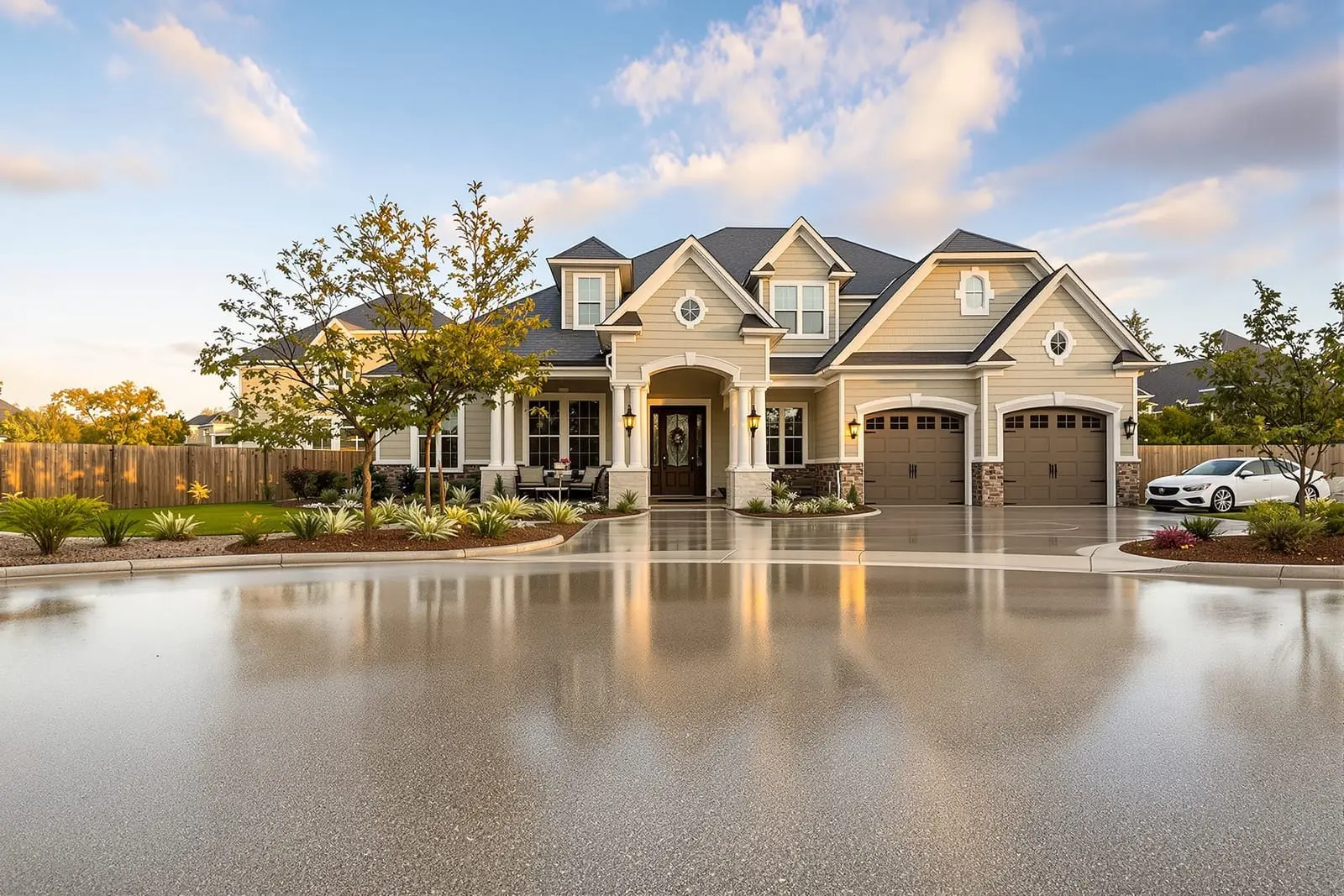
Partner with a dependable team for municipal concrete paving in Grand Rapids, MI. We complete sidewalks, streetscapes, medians, crosswalks, and public plazas to plan specifications. Our crews are experienced with phasing, traffic control, and inspections on city and county projects.
Primetime Concrete Grand Rapids provides professional municipal concrete paving throughout Grand Rapids, MI and the surrounding area. Our licensed, insured crew delivers safe, clean, on-time work with a free estimate before anything begins. Call (231) 888-1647 or request your free quote.
Municipal & Site Concrete Paving in Grand Rapids
Municipal concrete paving in Grand Rapids is not just about pouring sidewalks. It is about building durable public infrastructure that handles freeze-thaw cycles, heavy traffic, and ADA requirements without constant repairs. Primetime Concrete Grand Rapids focuses on municipal and site concrete projects that have to perform in real West Michigan conditions, from Lake Effect snow to spring thaw.
We partner with cities, townships, school districts, HOAs, and commercial site owners across the Grand Rapids area to design and install concrete pavements that stay serviceable and safe. Whether it is a downtown streetscape, a neighborhood sidewalk infill program, or site concrete around a new public building, we approach each project with a focus on longevity and constructability.
Because we work locally year after year, we understand Kent County specifications, typical inspector expectations, and how to phase work so public access is maintained. That local experience is as important as the concrete mix itself when it comes to municipal and site projects.
Typical Municipal & Site Concrete Applications
Municipal concrete paving covers a wide range of structures, and each has different performance requirements. Primetime Concrete Grand Rapids regularly installs:
• Public sidewalks and shared-use paths, including infill in established neighborhoods and new networks in growing developments.
• Curb and gutter sections that control drainage and define travel lanes, including integral curb for parking lots and barrier curb along collectors and arterials.
• Intersection work such as crosswalk panels, ADA-compliant curb ramps, detectable warning surfaces, and concrete bus pads.
• Site concrete around municipal facilities like fire stations, libraries, schools, and parks, including service slabs, dumpster pads, and equipment pads.
• Parking lots and drive lanes for public buildings and large private sites where concrete is preferred over asphalt for longevity and load capacity.
Each of these uses requires specific thicknesses, base preparations, and reinforcement details. For example, a residential sidewalk section in Grand Rapids might be 4 inches thick with fiber reinforcement, while a bus pad at a RAPID stop could be 8 inches or more with steel reinforcement and higher strength concrete. We design and build to those differences instead of using a one-spec-fits-all approach.
How We Plan and Phase Municipal Concrete Work
Successful municipal concrete paving starts with planning. Before work begins, Primetime Concrete Grand Rapids reviews the project plans, local standards, and site constraints in detail. On city or MDOT projects we coordinate with the engineer, utility owners, and inspectors to clarify specs on expansion joints, dowel bars, surface tolerances, and ADA slopes.
We then develop a phasing plan that maintains pedestrian access and, where needed, vehicle access. For example, in a downtown sidewalk replacement we may work half-width at a time to keep entrances open, or schedule night or weekend pours in front of high-traffic businesses. On school or park projects, we coordinate around events, bus traffic, and seasonal use.
Traffic control is a major component of municipal work. We set up detours, barricades, and signage consistent with local requirements and MUTCD guidance. Clear communication with nearby property owners is part of our process, so people know when access will change and when concrete will be ready for foot or vehicle traffic.
Our Concrete Installation Process Step by Step
Once planning is complete, the on-site work follows a precise sequence.
1. Layout and removals: We confirm line and grade, mark saw cuts, and remove existing pavement or vegetation. For replacement sidewalks we pay attention to existing door thresholds and adjacent landscaping to avoid creating trip hazards or drainage problems.
2. Subgrade preparation: We excavate to design depth, then compact the subgrade and aggregate base to the density required by the specifications. In West Michigan soils, this step is critical. Poor compaction is a leading cause of settlement and cracking, so we use plate compactors or rollers and proof roll when needed.
3. Forming and reinforcement: Forms are set to line and grade and double checked with string lines or lasers. We install any required dowels, tie bars, wire mesh, or rebar. For municipal sidewalks and patches in Grand Rapids, we commonly use fiber-reinforced concrete to improve crack control and reduce corrosion-prone steel.
4. Placing and finishing: Concrete is placed quickly to maintain a consistent slump, then screeded to elevation. We bull float, edge, and joint the surface according to the jointing plan. Finally, we broom finish to provide slip resistance, paying close attention to ADA cross slope and running slope limits so ramps and walks pass inspection.
5. Curing and protection: We apply curing compound at the right coverage rate or use wet curing where specified. Proper curing is essential in our climate, since rapid moisture loss leads to shrinkage cracking and reduced strength. We control access with barricades until the concrete reaches adequate strength for pedestrians or vehicles.
Throughout the process, our foreman stays in contact with the inspector so any questions get resolved before they become punch list items.
Design and Material Choices for Grand Rapids Conditions
Municipal concrete paving lives outdoors in extreme temperature ranges. Primetime Concrete Grand Rapids uses mixes and details that perform in our freeze-thaw environment.
Concrete mix: We typically work with 4000 to 4500 psi air-entrained mixes for exterior municipal work in Grand Rapids. Air entrainment helps the concrete survive repeated freeze-thaw cycles and exposure to de-icing salts. Where heavier loads are expected, such as at dumpster pads or bus stops, higher-strength mixes may be specified.
Thickness and reinforcement: Sidewalks are usually 4 inches, drive approaches and alleys 6 inches or more, and heavy-duty pads 8 inches or more with steel reinforcement. We recommend dowel connections at pavement transitions where differential movement is likely, especially at street intersections and commercial driveway approaches.
Expansion and contraction joints: Proper joint spacing and depth control cracking. In our climate, we often see failures where joints were spaced too far apart or not saw-cut on time. We plan saw cutting windows around temperature, mix, and pour time to get clean joints before random cracks form.
Surfaces and slopes: ADA compliance is non-negotiable on municipal projects. We pre-plan ramp and landing slopes, then verify during finishing to avoid costly rework. Detectable warning plates are set flush and anchored properly so they do not work loose from snowplows or shoveling.
Costs, Scheduling, and Best Times of Year
Municipal and site concrete costs in Grand Rapids are driven by more than square footage. Factors that influence pricing include thickness and strength of the concrete, type and amount of reinforcement, demolition and disposal needs, complexity of forming, traffic control requirements, and schedule constraints such as night or weekend work.
For example, a straightforward sidewalk replacement on a clear lawn strip will be less expensive per square foot than a tight downtown corner ramp with brick pavers adjacent and complex traffic control. Similarly, pours that require heating and tenting in cold weather will cost more than those performed in mild temperatures.
In West Michigan, the best time to schedule municipal concrete paving is typically late April through October, when ground temperatures and air temperatures support proper curing without extensive cold weather protection. We do perform work outside this window, but we must plan for blankets, heaters, non-chloride accelerators, and stricter timing, which adds cost.
Lead time matters as well. For public projects, permitting and approvals can take several weeks. Early coordination with Primetime Concrete Grand Rapids helps align bidding, approvals, and construction with the ideal weather window and any grant or fiscal year deadlines you must meet.
What to Look For in a Municipal Concrete Contractor
Choosing the right contractor for municipal concrete paving affects long-term maintenance budgets and public satisfaction. Here are practical points to evaluate.
Local standards experience: Municipal work in Grand Rapids and surrounding communities follows specific details from local standards, MDOT, or project engineers. We are familiar with these, including typical curb profiles, ramp layouts, and jointing patterns, which reduces back-and-forth in the field.
Quality control: Ask how field crews handle slump checks, air content testing, and finishing tolerances. On our projects, we coordinate with the testing lab, verify test frequencies, and adjust mix placement or finishing techniques when conditions change, such as sudden temperature swings or unexpected wind.
ADA and inspection track record: Failed ADA ramps and sidewalks can trigger rework and delays. We approach ADA compliance as a layout and finishing challenge, not as an afterthought. Our crews are trained to check slopes, landings, and transitions in real time rather than waiting for final inspection.
Communication: Municipal and site projects impact the public directly. Primetime Concrete Grand Rapids assigns a point of contact who provides schedule updates, responds to property owner questions, and coordinates with inspectors and engineers. That communication keeps projects moving and reduces complaints while work is underway.
“
Professional municipal & site concrete, done right the first time, quality materials, honest pricing, and results that last.