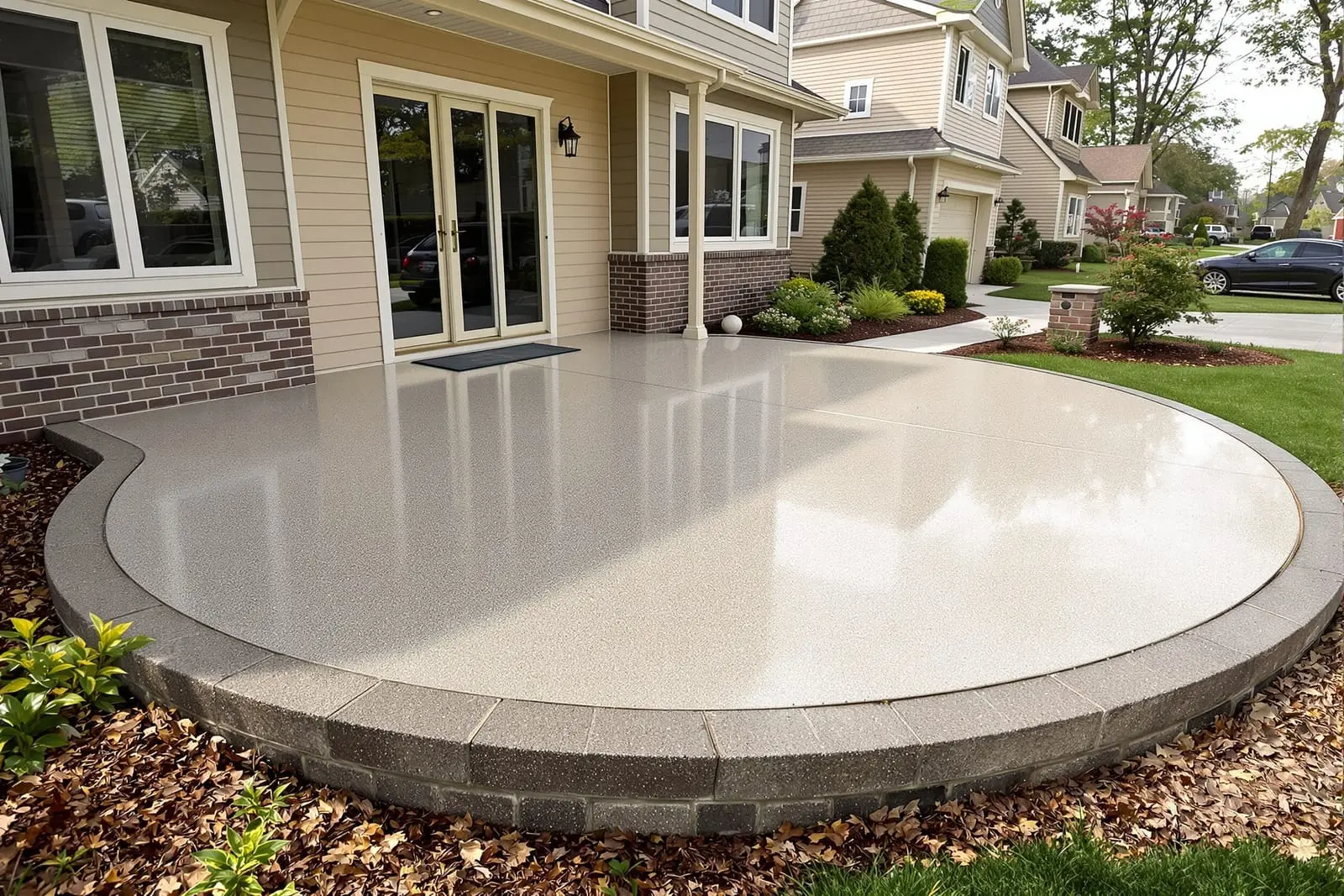
Create an outdoor entertaining space with professional concrete patio installation in Grand Rapids, MI. We pour patios sized and shaped to fit your backyard, from simple slabs to multi level layouts. Our crews handle grading, forms, and finishing for a stable, long lasting surface. Enjoy a low maintenance patio ready for furniture, grills, and gatherings.
Primetime Concrete Grand Rapids provides professional concrete patio installation throughout Grand Rapids, MI and the surrounding area. Our licensed, insured crew delivers safe, clean, on-time work with a free estimate before anything begins. Call (231) 888-1647 or request your free quote.
Concrete Patio Installation in Grand Rapids Done the Right Way
Concrete patio installation looks simple from the outside, but in West Michigan it has to be built for freeze and thaw cycles, clay soils, and heavy use. Primetime Concrete Grand Rapids focuses on patios that will not heave, crack early, or drain toward your house.
When you call us, we start with a site visit, not a guess over the phone. We look at slope, where water currently flows, how close the patio will be to your foundation, and what kind of access we have for equipment. We measure shade, sun, and typical wind on your property so we can talk through how hot the surface might get in July and how icy it may be in January.
From there we give you a written plan that covers the base depth, concrete thickness, reinforcement, control joint layout, and finish type. The goal is a patio that handles Michigan winters without expensive repairs after a couple of years.
Our Step-by-Step Patio Build Process
Primetime Concrete Grand Rapids follows a consistent concrete patio installation process so clients know what to expect.
1) Layout and excavation: We mark the exact footprint with paint and string lines. Then we strip sod and topsoil, usually 6 to 10 inches deep depending on soil conditions and whether you will be parking anything heavy on the slab. In some Grand Rapids neighborhoods with loamy or sandy soil we may dig a bit less, in areas with soft or clay-heavy soil we go deeper to reach stable ground.
2) Sub-base and compaction: We install a compacted base of crushed concrete or limestone, generally 4 to 6 inches. This is compacted in thin lifts with a plate compactor so the base does not settle. A solid base is the most important defense against frost heave.
3) Forms and slope: We set sturdy forms with stakes and verify slope with a laser level. A typical patio is sloped about 1/8 to 1/4 inch per foot away from the house so water moves off the slab instead of toward your foundation or basement windows.
4) Reinforcement: Based on the patio use, we install either welded wire mesh or rebar grid. For larger patios or ones that tie into steps or retaining walls we usually recommend #3 or #4 rebar on a set pattern, tied and supported on chairs so it sits in the middle of the slab, not on the ground.
5) Concrete placement and finishing: We use a mix designed for exterior flatwork in our climate, generally 4000 psi with air entrainment to handle freeze and thaw. We place, screed, bull float, then either broom, stamp, or trowel finish based on your choice. Joints are cut at the right time so the slab cracks where we plan it to, instead of randomly.
6) Curing and cleanup: For most patios we apply a curing compound or light sealer the same or next day. We remove forms, backfill edges, and make sure downspouts and yard drainage are working with the new concrete, not against it.
Design Options That Work in West Michigan Weather
Because we work only in concrete, we can offer a range of finishes that still hold up through Grand Rapids winters. Primetime Concrete Grand Rapids will walk you through options and what they realistically look like after five to ten years outdoors.
Finish choices: A standard broom finish is common for low-slip traction and budget friendliness. For a higher-end look, we can do stamped concrete that mimics stone, slate, or brick. Stamped patios need the right sealer and maintenance schedule to survive our road salt and freeze cycles. Exposed aggregate is another choice, with the top paste washed off to show decorative stone while still providing good grip.
Color and borders: Integral color mixed into the truck will not peel like surface paint. We can also use release powders or stains to create multi-tone effects in stamped concrete. Borders are useful both for appearance and to help hide saw cuts. We often pour a smooth or broom border around a stamped field so shovel edges and snow blowers are less likely to damage the texture.
Layout and features: We can form curves, separate grilling or fire pit zones, or add thickened areas where a hot tub will sit. If you are considering a wood or gas fire pit, we will plan for clearances and heat exposure so the concrete does not spall. For patios that tie into walkways or driveway extensions, we coordinate joint lines and elevations so everything looks intentional instead of pieced together.
What Affects Cost of a Concrete Patio in Grand Rapids
Concrete patio installation pricing is driven by more than square footage. Primetime Concrete Grand Rapids explains these factors up front so there are no surprises.
Size and thickness: A simple 10x12 broom-finished patio at standard 4 inch thickness costs less per square foot than a multi-level stamped patio at 5 or 6 inches thick. Patios that will support a hot tub, outdoor kitchen, or heavy retaining features may need thicker concrete and more reinforcement.
Access and excavation: Yards with tight side yards, fences, or steep slopes can require more labor, smaller equipment, or even wheelbarrow placement instead of a direct truck chute. If we encounter poor soils, buried debris, or the need to haul away a lot of old concrete, that adds to time and disposal fees.
Finish and details: Stamped patterns, multiple colors, borders, steps, seat walls, and custom joint layouts all increase labor. Many homeowners choose to keep the main area in a simple broom finish and upgrade only a border or central section to control cost while still getting a custom look.
Season and schedule: In West Michigan, concrete work is most efficient from late April through October. Early spring and late fall pours can require special cold-weather measures like insulated blankets, accelerators, and later start times, all of which affect cost. If you want a patio ready for Memorial Day or Labor Day, it is smart to schedule several weeks ahead because those blocks fill quickly.
Timing, Weather, and Long-Term Durability
Grand Rapids weather has a direct impact on how and when we pour patios. Primetime Concrete Grand Rapids does not shortcut curing or cold-weather procedures, because that is where a lot of early failures start.
Best seasons: Late spring through early fall is ideal. We avoid placing new patios when overnight lows drop below freezing unless we plan for blankets and additives. In peak summer, we time pours earlier in the day to avoid rapid surface drying and plastic shrinkage cracking when the sun is strongest.
Cold weather pours: If you need work done late in the season, we can still pour with the right mix design and protection. This may include warm water in the mix, non-chloride accelerators, ground blankets, and delayed removal of forms so edges do not freeze. These steps help the slab gain strength before it experiences freezing temperatures.
Long-term care: A properly installed patio should be resealed every 2 to 3 years for decorative or stamped finishes and less often for standard broom slabs, depending on exposure. We advise keeping de-icing salt, especially products intended for asphalt or road use, off the concrete as much as possible. Sand or pet-safe ice melt is a better choice on residential patios. We also recommend redirecting downspouts so they do not dump water on the slab and then freeze repeatedly in winter.
What to Know Before You Hire a Patio Contractor
Before you commit to a concrete patio installation, it helps to know what to ask. Primetime Concrete Grand Rapids encourages homeowners to look past the lowest number and focus on how the work will actually be done.
Questions to ask: What base depth do you include and how do you compact it? What is the concrete strength and does it include air entrainment for exterior use? How thick is the slab and what reinforcement will you use? How will the patio be sloped and where will the water go? When will you cut control joints and how far apart will they be? A contractor who cannot answer these clearly is taking chances with your project.
Permits and codes: In many areas around Grand Rapids, a basic ground-level patio does not require a building permit, but there are exceptions, especially if the patio ties into a covered structure, sits over 30 inches above grade, or affects lot coverage. We help you confirm local requirements and can coordinate with your township or city when needed.
Working with your yard and house: We look for basement windows, existing cracks in foundation walls, and any signs of poor drainage. If the current grade already slopes toward your home, we may recommend adding a drain, changing the patio footprint, or lightly regrading the yard so your new concrete does not create water problems. Our aim is a patio that looks good and also works with your property for the long term.
“
Professional concrete patio installation, done right the first time, quality materials, honest pricing, and results that last.
Primetime Concrete Grand Rapids
Concrete Patio Installation Across Our Service Area