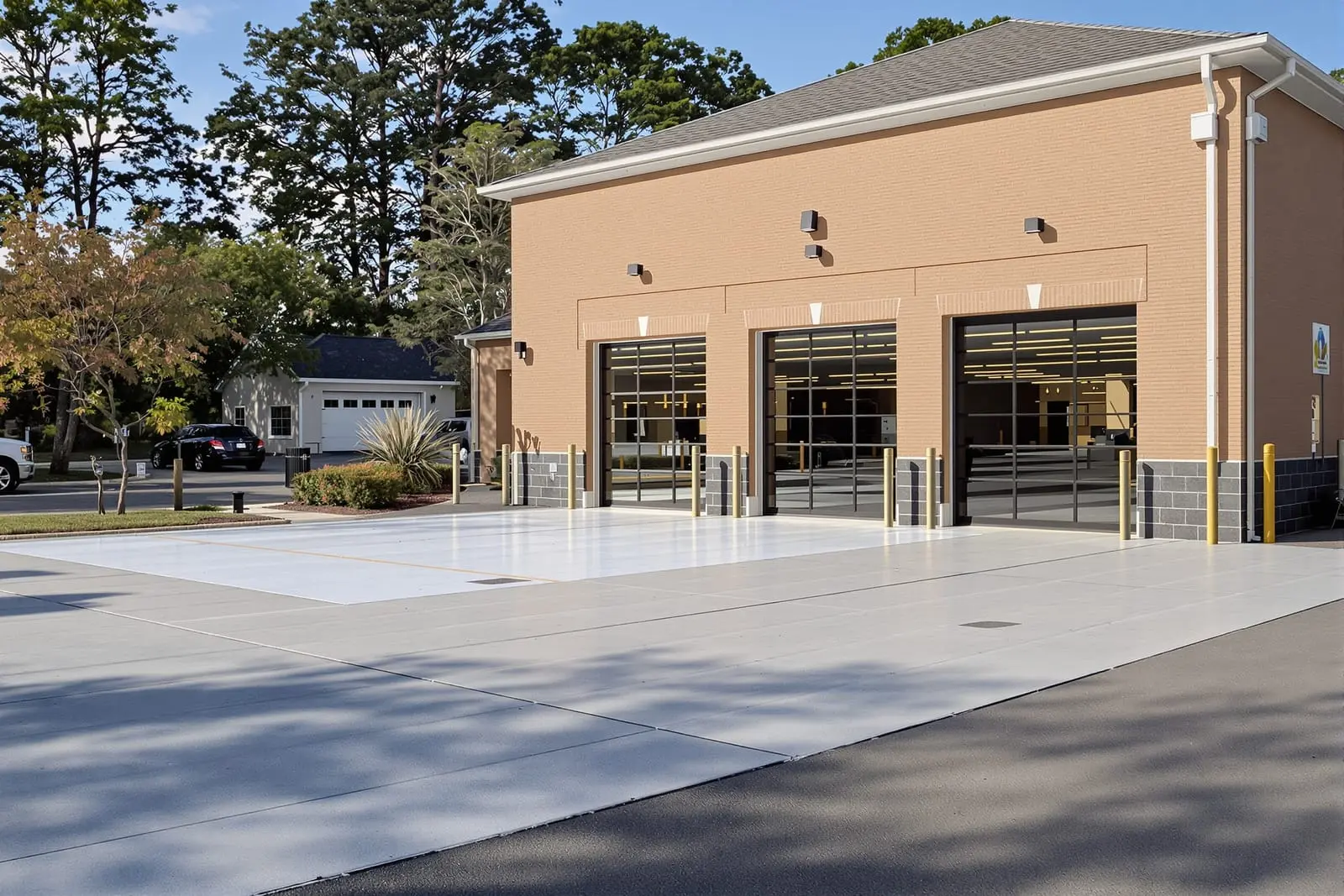
Support trucks and equipment with a properly built commercial concrete slab in Grand Rapids, MI. We pour loading docks, dumpster pads, and equipment foundations with the right thickness and reinforcement. Our slabs are designed for point loads, impact, and freeze thaw conditions common to commercial sites.
Primetime Concrete Grand Rapids provides professional commercial concrete slab throughout Grand Rapids, MI and the surrounding area. Our licensed, insured crew delivers safe, clean, on-time work with a free estimate before anything begins. Call (231) 888-1647 or request your free quote.
Commercial Concrete Slabs Built for West Michigan Workloads
Loading docks and commercial slabs in Grand Rapids take real abuse. Forklifts, semi trailers, freeze-thaw cycles, de-icing salts, and constant loading all find the weak spots in concrete. At Primetime Concrete Grand Rapids, we design and pour commercial concrete slabs that fit how your operation actually works, not just what looks good on paper.
We start by asking detailed questions about your use: What equipment runs on the slab, what the heaviest loads are, how often docks are used, whether you store racking or heavy inventory, and what kind of floor finish you expect. A light retail slab in a strip mall on 28th Street is a different animal than a warehouse receiving dock near the I-196 corridor or a food distribution center on the south side.
For most commercial projects around Grand Rapids, we recommend thicker slabs with properly designed reinforcement, a stronger mix than residential flatwork, and attention to subgrade drainage. Our goal is that your dock or slab handles your busiest days in February just as well as in July, without spalling, cracking, or settlement that stops work or damages equipment.
Planning loading docks and slabs for your specific site
Every loading dock or commercial concrete slab starts with site evaluation. In our region, soils can change a lot in a short distance. Around older industrial areas like the west side of Grand Rapids, we often see fill material that needs to be undercut and rebuilt. In newer business parks in Walker or Kentwood, we may have better native soils but tighter drainage requirements.
Primetime Concrete Grand Rapids checks soil conditions, existing subbase, nearby structures, and water paths. We look at how trucks will approach, whether trailers will sit level, and how snow will be plowed. For interior slabs, we consider column locations, racking layouts, control joint plans, and floor levelness requirements. Outside at docks, we review dock height, door types, dock levelers, and where wheel impacts will concentrate.
We then size the slab for your load and use. This includes thickness (often 6 to 8 inches or more for heavy duty areas), reinforcement type (rebar mat, doweled joints, or heavy welded wire), and concrete strength. A small local shop that receives one box truck a day does not need the same design as a 24 hour distribution center with constant semi traffic, and we price and design accordingly so you are not over or under built.
How we construct durable loading docks and commercial slabs
Once the plan is set, installation is all about sequence and quality control. First we prepare the subgrade. That usually means stripping soft material, compacting in lifts, and installing a proper base course, often 4 to 8 inches of compacted gravel or crushed concrete depending on the design. In Grand Rapids, where freeze-thaw cycles are severe, this base is critical to prevent frost heave and pumping.
For loading docks, we form dock faces, approach aprons, and any curb or bollard foundations. We make sure slopes move water away from the building and that the dock height matches your equipment. For interior slabs, we install vapor barriers where required, especially for warehouses that may later receive epoxy or polished concrete finishes. We then place reinforcement, tying rebar and positioning chairs so steel stays in the correct depth, rather than ending up at the bottom where it does little good.
Concrete placement is timed around local weather and your schedule. West Michigan temperature swings mean we plan pours to avoid rapid freeze in winter and too-fast drying in hot, windy weather. We use commercial mixes with the right air entrainment for exterior slabs, and we often increase cement content or use admixtures where higher early strength or reduced permeability is needed. During the pour, our crew focuses on vibration around embedded items and along forms to eliminate voids, which is especially important at dock edges and around bollard sleeves.
Finishing and jointing are just as important as thickness. For docks and outdoor slabs, we typically use a broom finish for traction and saw control joints at specific spacing based on slab thickness and layout. Inside warehouses, we coordinate with you on desired finish, from hard trowel for forklift traffic to more slip resistant textures near wet areas. All of this is done with the long term in mind so the slab can be maintained and repaired easily if needed.
Cost drivers, common problems, and how we prevent them
Commercial concrete slab pricing in the Grand Rapids area depends on more than just square footage. The main cost drivers are slab thickness, reinforcement type and density, subbase preparation, access for concrete trucks, and any special details like dock leveler pits, built in drains, or thickened edges at dock faces.
Existing conditions also impact cost. Replacing a failed slab in an older plant near downtown often means removal of unknown fill, working around utilities, and tight access that may require pumping concrete instead of direct chute placement. In contrast, a new build in an open industrial park can usually be placed more efficiently. At Primetime Concrete Grand Rapids, we walk the site and explain where your dollars are going so there are fewer surprises during construction.
Many of the slab failures we are called to fix have the same root causes: poor subgrade compaction, underdesigned thickness for the loads, lack of dowels at joints, or improper slope and drainage that leaves water and salt sitting where trucks and forklifts run. In winter, that trapped moisture freezes and breaks the surface. We address these issues up front by verifying compaction, using doweled contraction joints where appropriate, and designing slopes and drain locations that match real world snow and water patterns in West Michigan.
We are also direct about limitations. Concrete will crack, but cracks can be controlled and managed. We place control joints with a plan, use proper curing methods, and discuss where heavy traffic lines will fall so joints do not end up directly under your racking or dock equipment. When your operation has special concerns, like freezer rooms or food processing, we coordinate with your other contractors so floor performance supports code and hygiene requirements as well as durability.
What Grand Rapids owners should know before hiring a concrete contractor
If you are planning a loading dock or commercial concrete slab in the Grand Rapids area, a little preparation will help you get better bids and a better finished product. First, gather your anticipated loads. That includes forklift models and capacities, typical pallet weights, whether you use reach trucks or standard forklifts, and any point loads like racking legs or machine bases. This information lets Primetime Concrete Grand Rapids design a slab that fits your use instead of guessing.
Next, think through drainage and winter use. Where will snow be piled, how will meltwater run, and will salt or chemical deicers be used at dock approaches and walkways. Local winters are hard on flatwork, so your contractor should talk about air entrainment, slopes, and sealing. Ask how they handle cold weather concreting if your schedule pushes into late fall or early spring.
When you compare contractors, do not just look at thickness and price. Ask what concrete strength they are using, what reinforcement is included, whether joints will be doweled, how many inches of base stone are in the bid, and how curing will be handled. On commercial work, also ask about sawcut timing and joint layout. Poorly timed cuts lead to random cracking, and a sloppy layout makes future repairs difficult.
Finally, check that your contractor is comfortable working in active facilities. Many Grand Rapids businesses cannot shut down to pour a slab. Primetime Concrete Grand Rapids regularly stages work in phases, does early morning or off shift pours, and coordinates with your operations team so you keep shipping, receiving, or production going while we build the slab that will support your business for decades.
“
Professional loading docks & commercial slabs, done right the first time, quality materials, honest pricing, and results that last.
Primetime Concrete Grand Rapids
Loading Docks & Commercial Slabs Across Our Service Area